Tuesday, September 18, 2012

X - The Ten Instruments Mars Rover Curiosity Carries : Dynamic Albedo of Neutrons


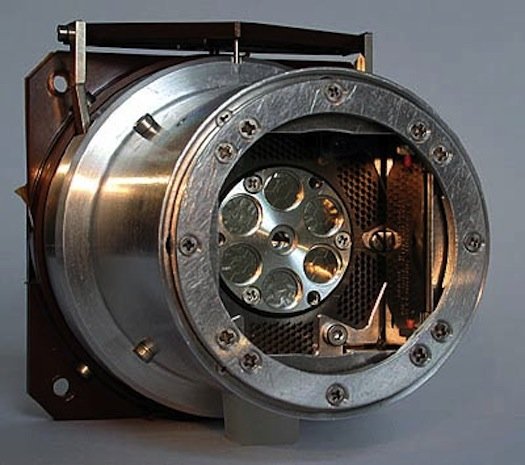
Dynamic Albedo of Neutrons

NASA/JPL-Caltech


Even if Curiosity doesn't, say, run into a puddle, there are still ways for it to discover water on Mars. Cosmic rays constantly hit the planet's surface, knocking neutrons out of orbit. Hydrogen atoms in water or ice will slow those neutrons down, and that can be detected.
A pulsing neutron generator called the Dynamic Albedo of Neutrons (DAN) can detect water content as small as one-tenth of 1 percent. DAN will send a beam of neutrons into the surface, three to six feet into the ground; if it detects a large amount of slower neutrons, that's decent evidence there's water underneath.

Click to see more

Friday, August 17, 2012

IX - The Ten Instruments Mars Rover Curiosity Carries : The Sample Analysis at Mars Instrument


The Sample Analysis at Mars Instrument

NASA/JPL-Caltech/Goddard Space Flight Center


The Sample Analysis at Mars (SAM) instrument is the technology behemoth of the Mars Rover Curiosity mission. A suite of three instruments, it makes up more than half of the scientific payload of Curiosity, and focuses on striking gold by finding evidence of life on Mars. The mass spectrometer, gas chromatograph, and tunable laser spectrometer inside can find compounds of carbon, such as methane, while also searching for lighter elements that might also indicate life, like hydrogen, oxygen, and nitrogen.
The mass spectrometer will separate elements by mass, the gas chromatograph will vaporize samples using heat to analyze them, and the laser spectrometer will measure how much of various isotopes are in the samples. Accurate to within 10 parts per thousand, it may be the best chance Curiosity has of discovering life--past or present.

Thursday, August 16, 2012

VIII - The Ten Instruments Mars Rover Curiosity Carries : Chemistry and Mineralogy X-Ray Diffraction Instrument


Chemistry and Mineralogy X-Ray Diffraction Instrument

NASA/JPL-Caltech


Mars Rover Curiosity's mission isn't just one that represents the future of space tech; it's also about uncovering the history of Mars. Minerals can be a strong indication of what the planet looked like as it was forming. Certain minerals, for example, may indicate that lava once flowed near a certain area. The chemistry and Mineralogy X-Ray Diffraction Instrument (CheMin) will be able to find and analyze those and a whole lot more.
Curiosity will be able to drill into rocks and collect a powder, then store it internally. CheMin will shoot tiny X-rays at the rock or soil sample; when they interact with it, some are absorbed and re-emitted at different energies. By calculating those energies, CheMin will be able to determine the atoms present in the sample.
What minerals they discover might also hint at how much of a role water played in forming the planet's minerals. Certain minerals contain water, and CheMin can tell the difference between those and the waterless variety. It might even clue scientists in on if Mars could have once supported life.

Wednesday, August 15, 2012

VII - The Ten Instruments Mars Rover Curiosity Carries : Alpha Particle X-Ray Spectrometer


Alpha Particle X-Ray Spectrometer

NASA/JPL-Caltech/Cornell/Max Planck Institut für Chemie/University of Guelph


To get an accurate analysis of samples on Mars, the Alpha Particle X-Ray Spectrometer (APXS) works up close. When it makes contact with a rock or soil sample, it'll bombard it with alpha particles and X-rays emitted as the element curium, placed inside, decays. The rays knock electrons from the sample out of orbit, and the energy released can be measured by sensors. This much energy, you've got sodium. Count again, and you've got something else.
It works day and night, but can take a little while to get a thorough analysis: as long as two to three hours to determine all of the elements that a sample contains, although 10 minutes is enough to see the major elements at a glance.

Monday, August 13, 2012

VI - The Ten Instruments Mars Rover Curiosity Carries : The Rover Environmental Monitoring Station


The Rover Environmental Monitoring Station

NASA/JPL-Caltech


In addition to being a great geologist, The Rover Environmental Monitoring Station (REMS) will make Mars Rover Curiosity into a great cosmic meteorologist. In daily and seasonal reports, REMS will send scientists information on atmospheric pressure, humidity, UV radiation, wind speed and direction, air temperature, and ground temperature.
Two booms will monitor wind speed, helping us to understand how breezes and one of the biggest weather phenomena on Mars, dust, operate. An inner sensor exposed to the atmosphere will catalogue changes in pressure caused by changes in the weather, and a filter keeps all the unwanted dust out.